
Buying your first home is an exciting milestone, but it can also feel like there is a lot to figure out at once. How much do you need for a down payment? What can you realistically afford? Which neighbourhood should you choose? And what first-time home buyer programs are available in 2026?
If you're planning to buy your first home in Vaughan, Thornhill, Maple, Kleinburg, Woodbridge or another York Region community, understanding the process before you start viewing properties can make your home search much easier.
The good news is that first-time buyers in 2026 have access to several federal and Ontario programs designed to make homeownership more attainable.
Here is what you should know before buying your first home this year.
Is 2026 a Good Year to Buy Your First Home?
There is rarely a perfect year to buy real estate.
The better question is whether you are financially and personally ready to own a home.
Instead of trying to perfectly time the housing market, first-time buyers should focus on factors they can control:
- Stable income
- Manageable debt
- A realistic down payment
- Emergency savings
- Comfortable monthly housing costs
- Plans to stay in the home long enough for ownership to make sense
For buyers looking in Vaughan, affordability can also vary considerably depending on the neighbourhood and property type.
A condominium near the Vaughan Metropolitan Centre, a townhouse in Vellore Village, an older detached home in Maple, and a luxury property in Kleinburg can all represent very different budgets.
Knowing what you can comfortably afford should come before deciding how much a lender is willing to approve.
1. Understand How Much Down Payment You Need
Your minimum down payment in Canada depends on the purchase price of the property.
For homes priced at $500,000 or less, the minimum down payment is 5%.
For properties between $500,000 and $1.5 million, buyers generally need:
- 5% on the first $500,000
- 10% on the amount above $500,000
Properties priced at $1.5 million or more generally require at least 20% down. Buyers putting down less than 20% will typically require mortgage loan insurance.
Example
If you purchased a home for $800,000, the minimum down payment would be:
5% of the first $500,000 = $25,000
10% of the remaining $300,000 = $30,000
Minimum down payment: $55,000
Remember that your down payment is only one part of the money you should have available.
There will also be closing and moving expenses.
2. Take Advantage of the First Home Savings Account
One of the most valuable tools available to Canadian first-time buyers is the First Home Savings Account, or FHSA.
In 2026, an eligible buyer can generally contribute up to $8,000 per year, with a lifetime contribution limit of $40,000.
Contributions may generally be deducted from taxable income, while qualifying withdrawals used toward purchasing a first home can be withdrawn tax-free.
That makes the FHSA particularly powerful because it combines features commonly associated with both an RRSP and a TFSA.
One important detail
Your FHSA contribution room generally begins after you open your first FHSA. Simply being eligible does not automatically begin accumulating room.
If homeownership is part of your future plan, opening an FHSA earlier may therefore be worth discussing with your financial advisor.
3. You May Be Able to Use Up to $60,000 From Your RRSP
Another option is Canada's Home Buyers' Plan (HBP).
The program currently allows eligible buyers to withdraw up to $60,000 from their RRSP toward purchasing or building a qualifying home.
Couples who both qualify may potentially use their respective HBP withdrawals toward the same home.
Even better, qualifying buyers can potentially use both an FHSA withdrawal and the Home Buyers' Plan when purchasing the same property, provided they satisfy the requirements for both programs.
A useful 2026 change
For buyers making their first HBP withdrawal between January 1, 2026 and December 31, 2028, temporary repayment relief means the 15-year repayment period begins in the fifth year following the year of the first withdrawal.
For example, someone making their first withdrawal in 2026 would begin required repayments in 2031.
4. First-Time Buyers Can Access 30-Year Insured Mortgages
Mortgage rules have also become more flexible for first-time buyers.
Eligible first-time home buyers can access 30-year amortizations on insured mortgages, which can help reduce the required monthly mortgage payment compared with a shorter amortization period.
Canada also increased the price ceiling for insured mortgages to $1.5 million. These changes have been in effect since December 15, 2024.
A longer amortization can improve monthly cash flow, but it is important to understand the trade-off.
You will generally pay more interest over the lifetime of the mortgage.
Rather than choosing a mortgage based solely on the lowest monthly payment, compare the complete cost with your mortgage professional.
5. New-Home Buyers Have a Major New 2026 Tax Break
One of the most notable developments for first-time buyers in 2026 is Canada's new First-Time Home Buyers' GST/HST Rebate.
Applications are now open.
Eligible first-time buyers purchasing a newly built or substantially renovated home may receive:
- Up to 100% of the federal GST portion for qualifying homes valued at $1 million or less
- A reduced rebate for homes valued between $1 million and $1.5 million
- A maximum federal rebate of $50,000
Homes valued at $1.5 million or more do not qualify for the federal first-time buyer rebate.
Generally, qualifying purchase agreements must have been entered into on or after March 20, 2025, along with additional construction, occupancy and ownership requirements.
Ontario buyers may qualify for additional relief
Ontario first-time home buyers may also be eligible for a rebate of up to $80,000 of the provincial portion of the HST on qualifying new homes, subject to the applicable requirements.
For someone considering a newly constructed townhouse or condominium in Vaughan, these programs make it especially important to understand the tax treatment of the property before signing an agreement.
Always have your accountant, lawyer or other qualified professional confirm your specific eligibility.
6. Don't Forget Ontario's Land Transfer Tax
Ontario buyers generally pay provincial land transfer tax when purchasing property.
Qualifying first-time home buyers may receive a refund of up to $4,000.
The maximum refund effectively eliminates Ontario land transfer tax on the first $368,000 of an eligible home's purchase price.
Vaughan is not subject to Toronto's separate municipal land transfer tax, which is another consideration when comparing properties in Vaughan with homes located inside the City of Toronto.
7. Get Pre-Approved Before You Fall in Love With a Home
One of the best steps a first-time buyer can take is obtaining a mortgage pre-approval before beginning serious property tours.
A pre-approval can help you understand:
- Your potential mortgage amount
- Estimated monthly payments
- Available interest rates and terms
- How your debts affect purchasing power
- The approximate price range you should be considering
It also prevents one of the most common first-time buyer mistakes: shopping for properties well above a comfortable budget.
Your maximum approval and your ideal budget do not necessarily have to be the same number.
Leave room for property taxes, utilities, maintenance, insurance, condo fees and everyday life.
8. Budget for More Than the Purchase Price
Many first-time buyers focus almost entirely on their down payment.
There are other expenses to consider.
Depending on the property and transaction, these may include:
- Land transfer tax
- Lawyer fees
- Title insurance
- Home inspection
- Appraisal
- Property insurance
- Adjustments on closing
- Moving expenses
- Immediate repairs or renovations
- Furniture and appliances
- Condominium fees
- Property taxes
Having cash reserves after closing is often just as important as accumulating the down payment.
Owning a home becomes much less stressful when an unexpected repair does not immediately create a financial emergency.
9. Choose the Neighbourhood Before Choosing the House
The home itself matters, but location can have an enormous influence on your everyday experience.
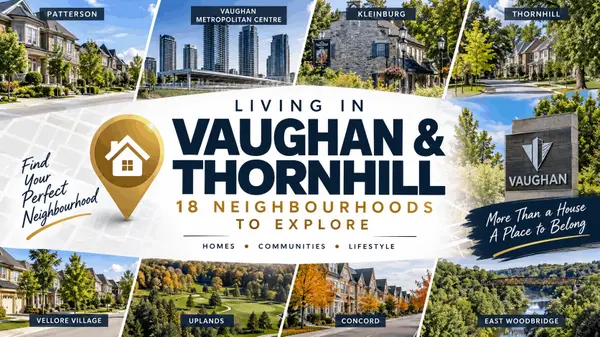
Vaughan gives first-time buyers several very different lifestyles to consider.
Vaughan Metropolitan Centre
Buyers looking for condominiums, transit access and a more urban environment may prefer the Vaughan Metropolitan Centre.
Maple
Maple offers an established suburban atmosphere with a mixture of detached houses, townhomes and condominiums.
Patterson
Patterson is popular with buyers seeking newer suburban housing and convenient access to different parts of Vaughan.
Vellore Village
Newer homes, parks and community amenities make Vellore Village another area worth considering.
Thornhill
Thornhill provides established neighbourhoods and convenient access toward Toronto, Richmond Hill and Markham.
Concord
Concord offers residential pockets close to major transportation and employment corridors.
Woodbridge
Woodbridge provides everything from established residential neighbourhoods to newer townhome and condominium developments.
Kleinburg
Kleinburg offers a distinctive village atmosphere with newer communities and higher-end housing surrounding its historic core.
First-time buyers should compare communities based on more than price alone.
Consider your commute, transportation needs, property type, nearby amenities and how your lifestyle might change over the next several years.
10. Decide Between a Condo, Townhome and Detached Home
Your first home does not necessarily have to be your forever home.
For many buyers, a condominium or townhouse is a practical first step into the real estate market.
Condominiums
Condos may offer a lower-maintenance lifestyle and can provide opportunities to enter neighbourhoods where detached properties would otherwise be outside the budget.
Remember to review:
- Monthly maintenance fees
- Reserve fund
- Status certificate
- Building rules
- Parking and locker ownership
- Upcoming major repairs
Townhomes
Townhouses can offer more living space while remaining more attainable than some detached homes.
Be sure to determine whether the property is freehold or part of a condominium corporation.
Detached and Semi-Detached Homes
These properties may provide more space, privacy and control but often come with greater maintenance responsibilities and potentially higher purchase prices.
There is no universally superior property type.
The best choice is the one that fits both your current finances and your plans for the next several years.
11. Don't Skip the Home Inspection Without Understanding the Risk
Competitive markets sometimes encourage buyers to remove conditions from their offers.
For a first-time buyer, however, purchasing a property without understanding its physical condition can create significant risks.
A professional inspection can potentially identify concerns involving:
- Roofing
- Electrical systems
- Plumbing
- Heating and cooling
- Foundation
- Moisture
- Windows and doors
- Insulation
- General maintenance
The appropriate offer strategy depends on the individual property and current market conditions.
Discuss the risks before removing conditions simply to make an offer appear stronger.
12. Think Beyond Your First Year of Ownership
When viewing homes, imagine your life several years from now.
Could you still comfortably make the payments if expenses increase?
Will the home provide enough space?
Could your commute change?
Would the property's layout still work for you?
How easy might the home eventually be to resell?
Your first property does not need to satisfy every future need, but thinking beyond move-in day can help you make a more confident decision.
A Simple 2026 First-Time Buyer Checklist
Before beginning your Vaughan home search:
1. Review your finances
Understand your income, savings, debt and monthly expenses.
2. Build your down payment
Consider whether an FHSA or Home Buyers' Plan could form part of your strategy.
3. Keep money available for closing costs
Avoid putting every available dollar into the down payment.
4. Get mortgage pre-approval
Establish a comfortable buying range.
5. Choose several neighbourhoods
Compare communities based on budget, lifestyle and commute.
6. Start viewing homes
Seeing properties in person will help refine your priorities.
7. Understand the property before offering
Review comparable sales, condition, taxes, condominium documents where applicable and other relevant information.
8. Build an offer strategy
Price is important, but deposit, closing date and conditions can also affect an offer.
9. Complete your due diligence
Work closely with your real estate professional, lender and lawyer.
10. Prepare for closing and move-in
Arrange insurance, utilities, funds and final closing requirements ahead of time.
Your First Home Doesn't Have to Be Perfect
First-time buyers sometimes delay purchasing because they are waiting for the perfect property, perfect interest rate or perfect market.
In reality, your first home simply needs to make sense for your finances, lifestyle and future plans.
Vaughan offers everything from urban condominiums and newer townhouses to established suburban communities and detached homes. Understanding your priorities can narrow those options considerably.
And with programs such as the FHSA, Home Buyers' Plan, Ontario land transfer tax refund, 30-year insured mortgages and new 2026 GST/HST rebates, it is worth understanding every benefit you may qualify for before making your purchase.
Ready to Buy Your First Home in Vaughan?
Buying your first home comes with plenty of questions, and you should not have to navigate every decision alone.
Whether you're exploring Patterson, Maple, Thornhill, Vellore Village, Concord, Woodbridge, Kleinburg or another Vaughan community, having a clear plan can help you move forward with confidence.
Start your first-home search today and discover which Vaughan neighbourhood fits your budget, lifestyle and next chapter.
Information in this article is general in nature and is not financial, tax, mortgage or legal advice. Government programs and eligibility requirements can change. Buyers should confirm current requirements with the appropriate government agency and qualified professionals before making financial decisions.